Error message

  • Deprecated function: Using ${var} in strings is deprecated, use {$var} instead in include_once() (line 1442 of includes/bootstrap.inc).
  • Deprecated function: Using ${var} in strings is deprecated, use {$var} instead in include_once() (line 1442 of includes/bootstrap.inc).
  • Deprecated function: Using ${var} in strings is deprecated, use {$var} instead in include_once() (line 1442 of includes/bootstrap.inc).
  • Deprecated function: Using ${var} in strings is deprecated, use {$var} instead in include_once() (line 1442 of includes/bootstrap.inc).
  • Deprecated function: Using ${var} in strings is deprecated, use {$var} instead in include_once() (line 1442 of includes/bootstrap.inc).
  • Deprecated function: Using ${var} in strings is deprecated, use {$var} instead in include_once() (line 1442 of includes/bootstrap.inc).
  • Deprecated function: Automatic conversion of false to array is deprecated in qtip_clean_settings() (line 787 of sites/all/modules/qtip/qtip.module).

DNA attraction in monovalent and divalent electrolytes
Binquan Luan, and Aleksei Aksimentiev
J Am Chem Soc 130(47) 15754-5 (2008)
DOI:10.1021/ja804802u  PMID:18975864  BibTex

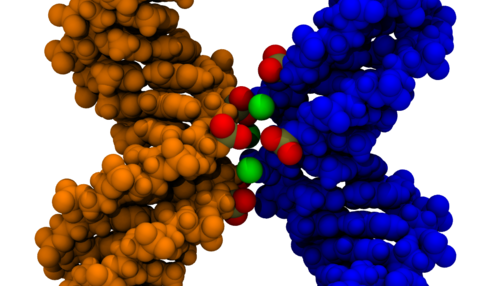
The dependence of the effective force on the distance between two DNA molecules was directly computed from a set of extensive all-atom molecular dynamics simulations. The simulations revealed that in a monovalent electrolyte the effective force is repulsive at short and long distances but can be attractive in the intermediate range. This attractive force is, however, too weak (approximately 5 pN per turn of a DNA helix) to induce DNA condensation in the presence of thermal fluctuations. In divalent electrolytes, DNA molecules were observed to form a bound state, where Mg(2+) ions bridged minor groves of DNA. The effective force in divalent electrolytes was predominantly attractive, reaching a maximum of 42 pN per one turn of a DNA helix.